Custom building looks different depending on where you're building. The block, the council, the climate, and the surrounding streetscape all shape what a finished home can be.
AHR Builders has completed projects across multiple Victorian locations, from growth corridor estates to coastal Bass Coast and inner Melbourne suburbs, and the range of outcomes tells you something useful about what custom building actually means in practice.
1. Cowes
Cowes is Phillip Island's main township, and it draws a broad mix of buyers, permanent residents, retirees, holiday homeowners, and investors attracted by the island's short-term rental market.
The AHR development here is a row of multi-dwelling townhouses. Each is two-storey, with a rendered lower level, grey horizontal weatherboard cladding to the upper level, pitched gable rooflines, and individual garages. Upper-level balconies with white balustrades face toward the street and the coastal canopy beyond.
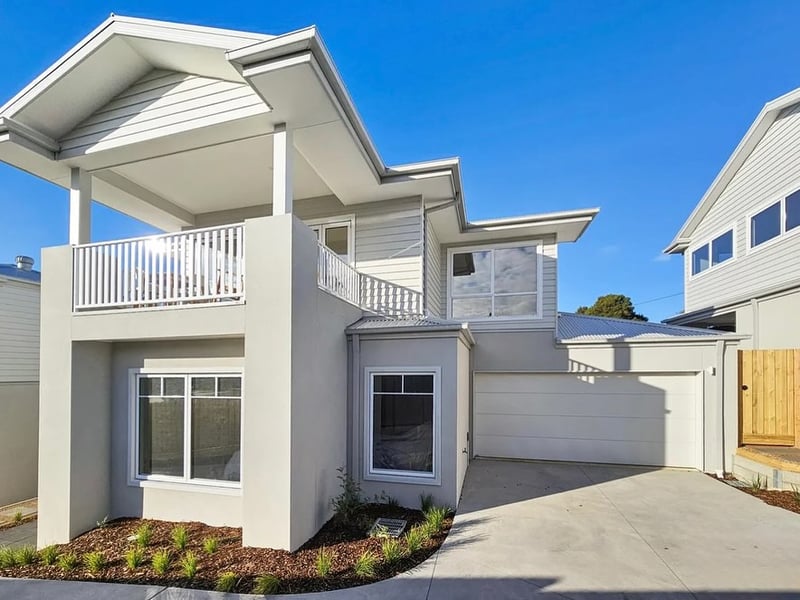
A multi-dwelling project on Phillip Island involves a different approval and construction process to a single custom home, staged inspections, shared services, and compliance across multiple dwellings at once. Buyers or landowners considering a development brief in this area should factor that process into their builder selection, not just the finished product.
2. Lysterfield
Lysterfield sits on Melbourne's south-east fringe, where the Urban Growth Boundary meets the Dandenong Ranges foothills. Blocks here tend to be larger than the typical estate allotment, and many carry meaningful slope.
AHR's build here is a two-storey rendered home shaped directly by the site: the upper level is where the living happens, oriented to capture an unobstructed outlook across the south-east suburbs to the CBD.
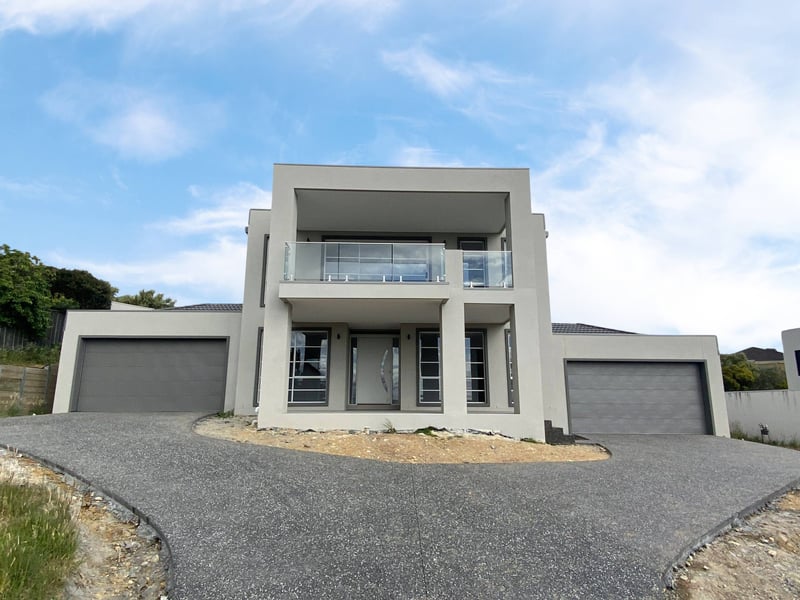
A wide balcony with frameless glass balustrade extends the internal living space outward, and the kitchen, stone waterfall island, full-height cabinetry, skylight, is positioned to share the same elevated view.
A sloping block in this area requires a builder who will design to the fall. The alternative, a levelled site and a standard plan, loses the outlook entirely.
The Lysterfield build shows what working with the site can produce when the design is structured around the fall from the start.
3. Cape Woolamai
Cape Woolamai is on Phillip Island's eastern tip, where Bass Strait exposure, coastal vegetation overlays, and Bushfire Attack Level ratings all come into play. Building here requires a builder who understands what the site conditions demand from materials, structure, and approvals, not just what the client wants the house to look like.
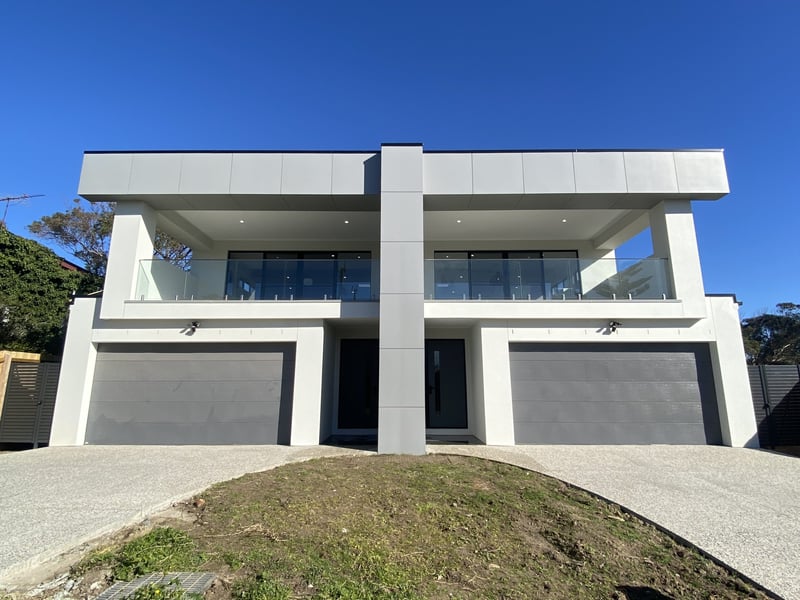
The AHR project here is a dual occupancy: two mirrored dwellings on a single coastal allotment, rendered white with large format cladding panels, flat parapet rooflines, and upper-level balconies with frameless glass balustrades. Each dwelling has a double garage. From the upper balcony, the outlook reaches past Norfolk pines, a reliable marker of the Cape Woolamai residential pocket, toward the coastal horizon.
Inside, the kitchen is clean and well-finished: white cabinetry, stone island with LED underlighting, frosted splashback window framing coastal scrub beyond.
The dual occupancy format on a coastal block is a more complex brief than a standalone custom home, involving separate metering, shared boundary treatments, and compliance across two dwellings simultaneously. Coastal BAL requirements add a further layer that affects material selection across the entire build.
4. Mount Martha
Mount Martha is an established suburb on the Mornington Peninsula's eastern shore. The Peninsula Planning Scheme applies here, and vegetation overlays affect many allotments, constraints that limit what can be cleared and how a build can be sited. The buyer profile skews toward owner-occupiers building for the long term.
The AHR build here is single-storey, using vertical timber cladding, black-painted cladding, and a granite rock retaining wall at the base, materials that respond to the native bush setting rather than contrast with it. The flat cantilevered roofline and large glazed panels keep the form contemporary without overriding the site character.
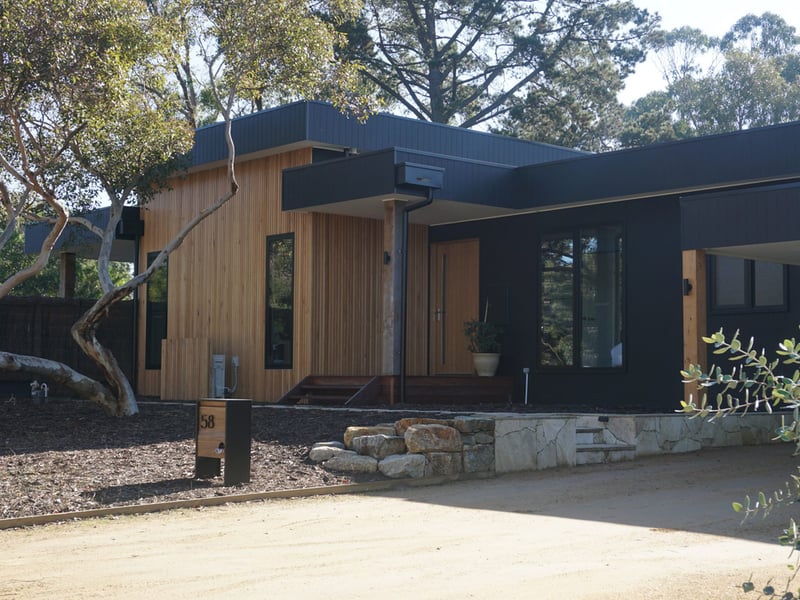
Inside, clerestory windows run along the roofline of the open-plan living and dining area, drawing in diffuse natural light without relying on a single large opening. The rear deck connects separately to both the master bedroom and the main living area via stacking and sliding doors.
Material selection in a bush-adjacent Peninsula location has practical consequences beyond aesthetics. Render, for instance, performs differently to timber cladding when salt air and vegetation are permanent neighbours. The choices here reflect a brief built for the site, not borrowed from a display village.
5. Cranbourne South
Cranbourne South sits at Melbourne's south-east edge, where residential streets give way to semi-rural allotments. The AHR build here is the most technically complex in the portfolio.
The home wraps two full walls of the living and kitchen zone in floor-to-ceiling black-framed glazing, with a clerestory tier above bringing additional light into a high-volume interior. A raked ceiling runs the length of the space, with exposed ducted heating and cooling ductwork left visible as a deliberate finish decision. A brick feature wall runs alongside a stone waterfall island bench. Beyond the glazing, a timber deck leads to a pool with glass fencing, a covered alfresco dining area, and a louvred pergola.
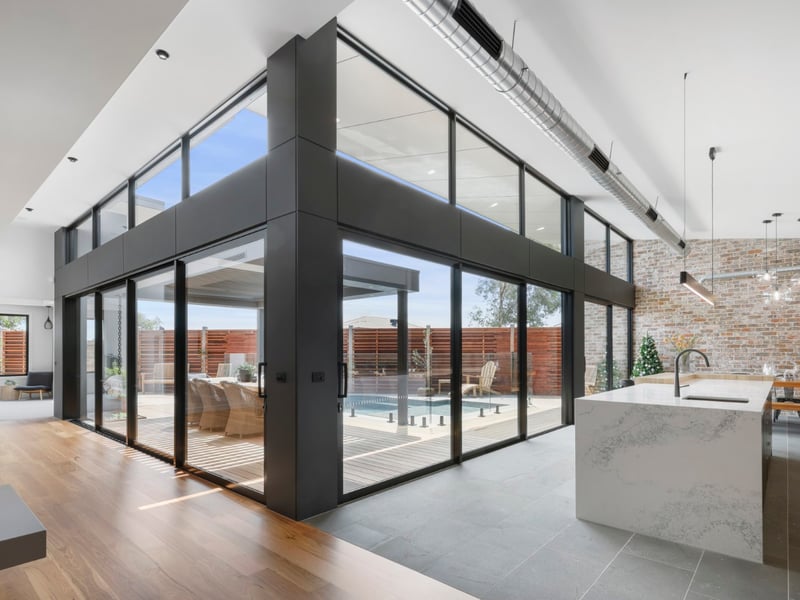
A glazing system spanning two walls with a clerestory tier requires precision in both structural design and thermal performance. Getting the junction between the glazed walls and the raked ceiling right is the kind of detail that separates a builder who has done it from one who hasn't.
The Cranbourne South project gives a clear reference point for what this scale of glazing, pool, and alfresco integration looks like in practice, and what it demands from the builder delivering it.
6. Pascoe Vale
Pascoe Vale is an established inner-north suburb, geographically and contextually removed from AHR's typical south-east and coastal corridor. It's a suburb of Federation-era housing stock, heritage overlays, and streetscapes where new builds are expected to respond to what already exists.
The AHR build here is a Federation-style home in sandstone block: full columns with decorative capitals, ornate gable truss, bullnose verandah with corrugated iron awning, tessellated tile entry. Heritage-style detailing at this level requires trades with specific skills in masonry, joinery, and decorative finish.
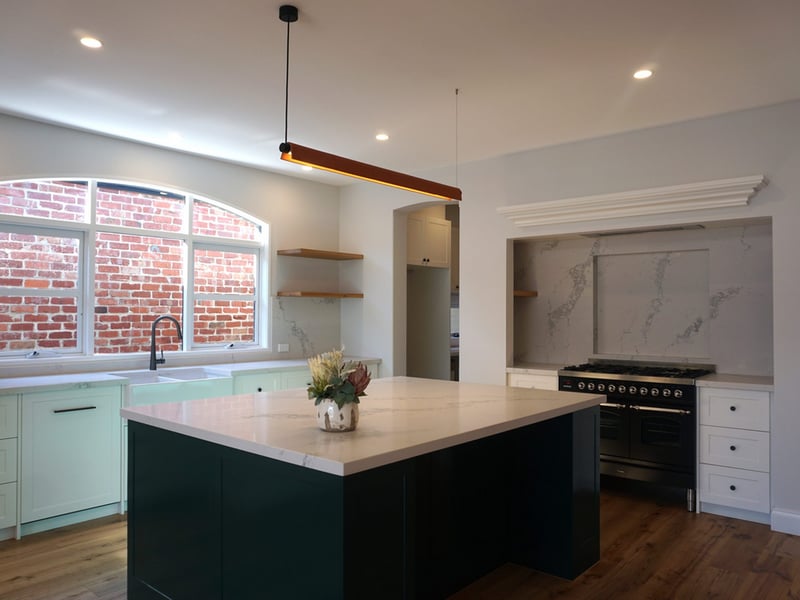
Inside, the kitchen carries the same approach, arched doorways, recessed cooking niche with full-height stone splashback within an ornate cornice surround, open timber shelving, dark hardwood floors. At the rear, the home transitions to a contemporary addition: a gabled roofline with a full triangular glazed gable end, tongue-and-groove timber ceiling lining, and black-framed sliders.
The Pascoe Vale build is a useful reference for what the heritage-front, contemporary-rear brief produces at the upper end of execution.
What these custom builds show
The locations are different, the briefs are different, and the outcomes are different, but the pattern across AHR's portfolio is consistent: each home is shaped by the specific conditions of its site, not applied over them.
A sloping Lysterfield block produced a view-oriented split-level. A bush allotment in Mount Martha produced a dark timber home that disappears into the setting. A Federation streetscape in Pascoe Vale produced a sandstone build with heritage detailing and a contemporary rear. None of these outcomes were available off a standard plan list.
For buyers comparing builders, that's the relevant question: does the builder you're speaking to have a record of delivering the brief you're bringing, on the site type, in the location, at the specification level you're considering?
Publisher Website: www.homeshelf.com.au