Building on acreage offers a type of freedom that suburban blocks rarely allow. Wider frontages, deeper setbacks and fewer immediate neighbours open the door to larger homes, longer sightlines and a stronger connection between indoor and outdoor space.
But that freedom also comes with complexity. On larger rural or semi-rural sites, good design is less about maximising floor area and more about how a home is arranged across the land, how it captures light, manages distance between spaces, and supports day-to-day living without feeling oversized or inefficient.
For buyers planning an acreage build, the most successful homes tend to share a few consistent traits: clearly zoned layouts, strong orientation, flexible living spaces, and a balance between openness and privacy. The following designs illustrate how different builders approach these principles in practice, offering useful reference points rather than one-size-fits-all solutions.
Montville 462 by G.J. Gardner Homes
Acreage as a series of connected living zones
On wider blocks, one of the biggest design opportunities is the ability to separate functions without disconnecting the home. The Montville 462 by G.J. Gardner Homes is a good example of this approach, using a sweeping, single-level layout to divide the home into distinct zones while maintaining a strong central heart.
The entry sequence establishes a sense of scale early, with formal lounge and dining spaces flanking the foyer before opening into a large open-plan living area. From here, the home branches into two wings: a private master retreat on one side and a secondary bedroom and games zone on the other. This configuration suits families who want separation between adult, children and guest spaces without resorting to multiple storeys.
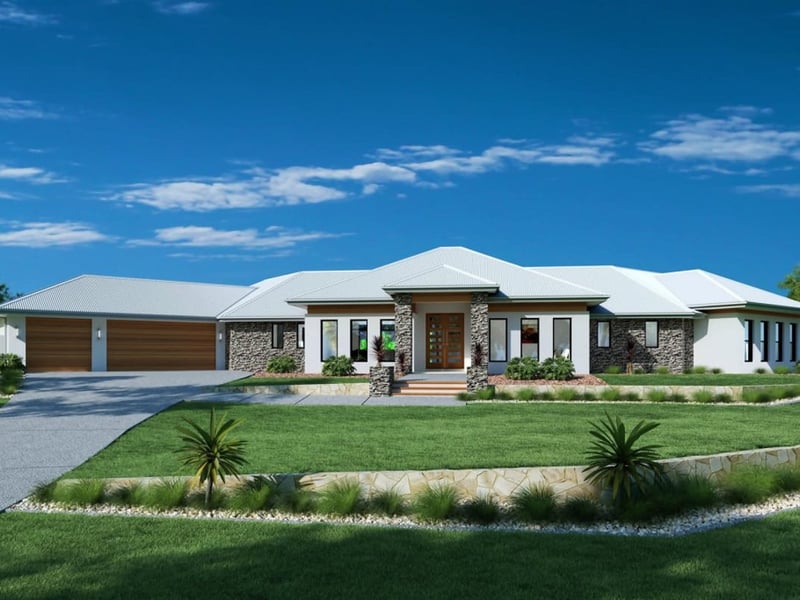
Montville 462, Resort facade by G.J. Gardner Homes
Outdoor living is treated as an extension of the internal layout rather than an add-on. Wraparound verandahs and a covered alfresco connect directly to the main living areas, reinforcing the indoor–outdoor relationship that acreage buyers often prioritise.
Importantly, the design is intended for north-facing rear sites, showing how orientation remains just as critical on large blocks as it is on compact ones.
Woodside by Sherridon Homes
A modern interpretation of the country manor
Acreage homes often lean either toward contemporary minimalism or traditional homestead styling. The Woodside by Sherridon Homes sits somewhere in between, borrowing familiar country proportions while maintaining a modern internal layout.
Designed for rural lots, the plan places a strong emphasis on everyday functionality. Features like a mudroom, butler’s pantry and concealed children’s retreat reflect the practical realities of acreage living, where outdoor activity, storage and circulation matter more than formal separation.
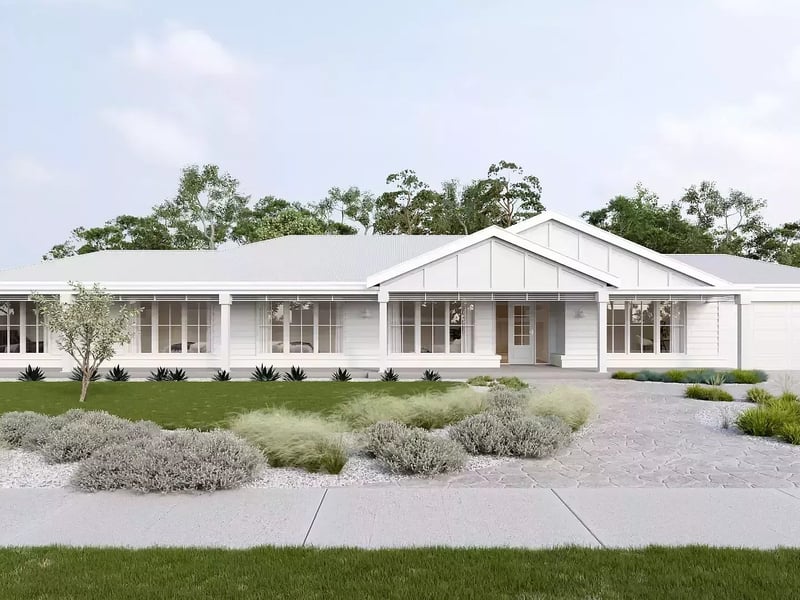
Woodside, Kingston facade by Sherridon Homes
The flexibility built into the Woodside is one of its defining characteristics. Buyers can adapt the plan to include a larger master suite, expanded alfresco areas or alternative living configurations depending on how the home will be used over time. This adaptability is particularly relevant on acreage, where families often plan to stay longer and need a home that can evolve.
Rather than using size alone to create impact, the Woodside demonstrates how proportion, flow and considered detailing can deliver a sense of generosity without unnecessary excess.
Jacaranda 45 by Simonds Homes
Using space to create privacy and structure
On very wide blocks, internal courtyards and separated entertaining zones can help prevent large homes from feeling linear or sprawling. The Jacaranda 45 by Simonds Homes applies this principle through a courtyard-style layout that divides the home into functional clusters.
Bedrooms line the frontage, with the master suite set apart for privacy, while the central alfresco acts as a visual and physical break between the kitchen and a secondary living area. This creates multiple focal points across the home, allowing different activities to occur simultaneously without overlap.
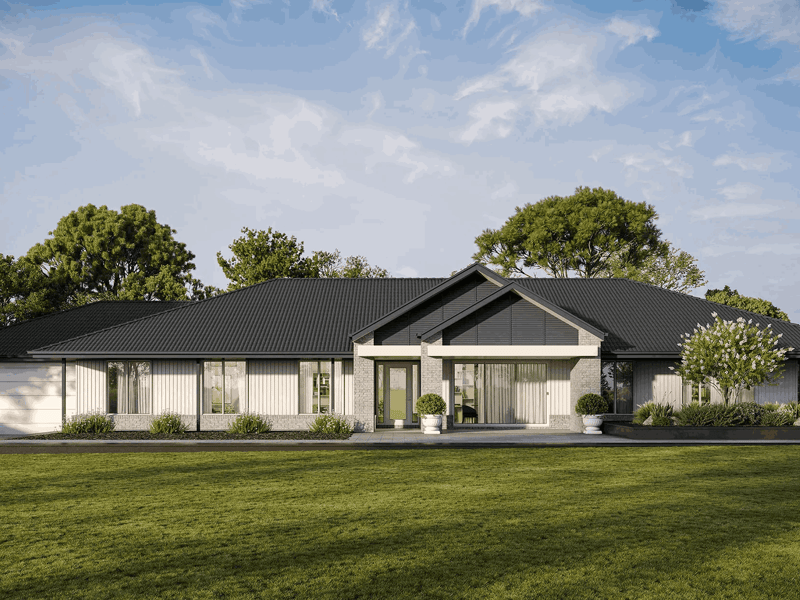
Jacaranda, Kingsley facade by Simonds Homes SA
With three living areas and a clear distinction between private and shared spaces, the design suits families who regularly entertain or accommodate guests. Practical inclusions such as a walk-in pantry, generous laundry and internal access garage reinforce the idea that acreage homes still need to perform efficiently, not just look impressive.
The Jacaranda 45 highlights how thoughtful planning can make a large home feel structured and intuitive rather than overwhelming.
Designing for land first, not just floor area
While each of these designs takes a different approach, they reflect a common shift in how acreage homes are being conceived. Buyers are increasingly focused on how a home sits on its land, how spaces relate to one another, and how the layout will support long-term living rather than short-term visual impact.
For those considering an acreage build, the most valuable inspiration often comes from understanding why certain plans work, not just what they include. Zoning, orientation, circulation and flexibility tend to matter far more than headline square metre figures.
Seen through that lens, these designs offer useful insight into how today’s builders are responding to the unique opportunities and challenges that come with building beyond the suburban boundary.
Publisher Website: www.homeshelf.com.au