Choosing a new home in a master planned community comes with layers of consideration that extend well beyond the lot itself.
For professionals and young families in particular, the decision often comes down not just to where a community sits, but how easily daily life will function once routines take hold.
Connectivity plays a central role in that assessment. Not simply in terms of distance, but in ease, choice, and the number of ways people can move through their week. These decisions quietly anchor work, school runs, errands and weekends to a specific part of Melbourne, often for decades rather than years.
It’s a question best asked early, not as a checklist item, but as a measure of whether everyday routines will still feel manageable once the novelty of a new home fades.
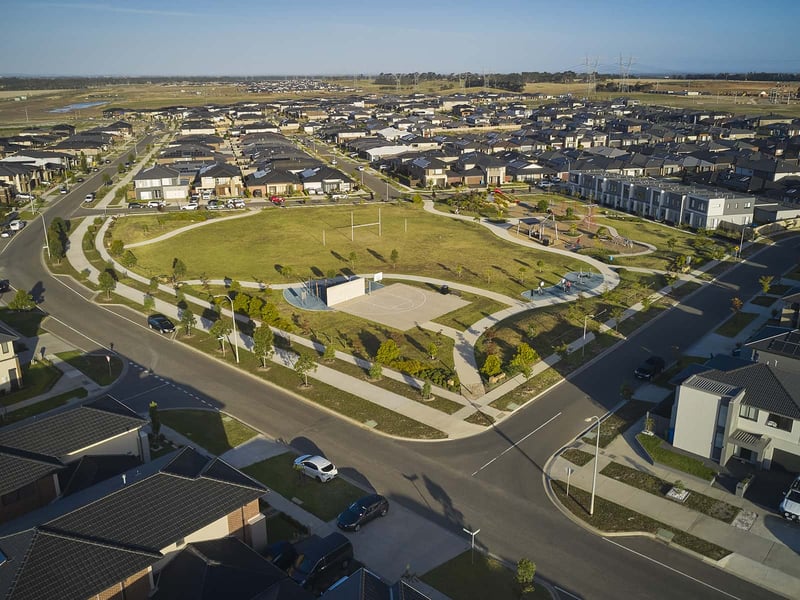
Brown Property Group’s Meridian in Clyde North has reached a point where those patterns are already visible. With more than 2,000 residents living in the community, it has evolved alongside surrounding amenities rather than ahead of it, attracting a mix of young families and first-time buyers seeking balance between connection and open space.
From Meridian, movement extends outward into Melbourne’s south-east without reliance on a single corridor. Berwick and Cranbourne sit within close reach, offering established town centres with employment, healthcare, schooling and retail, the kinds of destinations that tend to absorb daily life over time.
Direct access to the Princes Highway and Monash Freeway links the estate into the broader road network, but it’s the spread of nearby options, including Casey Central, St Germain Central, Fountain Gate and local medical hubs, that helps reduce dependence on long, repetitive trips in one direction.
As the area continues to grow, infrastructure is adjusting accordingly. Upgrades at key intersections, including works at Thompsons Road and Berwick–Cranbourne Road, are focused on improving traffic flow, safety and active transport capacity as population increases. These projects are rarely visible on a sales plan, yet they often have the greatest influence on how an area feels several years into daily use.

Within Meridian itself, the design emphasis is on keeping movement local where possible. Walking and cycling paths link parks, wetlands, schools and future town centre uses, shaping routines that don’t require getting in the car for every task, a detail that tends to grow in value over time rather than at the point of purchase.
This structure carries through to Meridian Green, one of the community’s newer precincts, where around 750 lots sit within walking distance of open space and a newly approved 450-metre linear park. The park will link the future government primary school within the precinct to the heart of the community, reinforcing patterns of everyday movement as families grow.
Seen this way, Meridian’s position in Clyde North isn’t about being “close enough” to the city. It’s about whether the surrounding network can support a settled, repeatable way of life as priorities shift and routines deepen.
In established growth areas, connectivity is rarely experienced as a promise. It’s a condition that shapes daily life over time, often revealing its true value only once routines have settled and the community is fully lived in.
Publisher Website: www.homeshelf.com.au